An ordinary companion becomes an exhibit
Before there was a judging schedule, there was an argument about attention. Harrison Weir wanted people to look more carefully at the cats already sharing their homes. In his own account, the animal by the fireside possessed qualities that familiarity had made easy to overlook. A show would make those qualities visible.
The Crystal Palace event of 1871 became a landmark in organized cat exhibiting. Its appeal is not only that it happened long ago. Weir’s description exposes the surprisingly practical work behind a cultural milestone: rules, entry fees, publicity, cats to gather and a public that still needed persuading.
An organizer remembers his experiment
Our principal source is Weir’s Our Cats and All About Them, first published in 1889 and available through Project Gutenberg. It is a participant’s retrospective account, rather than a neutral transcript written as the show unfolded. That makes it valuable and gives us a reason to notice his point of view.
Weir writes with affection, confidence and a strong sense of what the show ought to mean. He is explaining his own project. Read his recollections for the details he supplies, while keeping the distance between the event and the published book in view.
His later chapters also contain period beliefs and advice. A historical book can tell us what its author thought without becoming a present-day authority on genetics, nutrition or care. Here we are following the story of the exhibition, not recommending its husbandry.
The unglamorous architecture of a show
Weir recalls approaching Mr. Wilkinson, manager of the Crystal Palace, with his idea. He then worked out entry prices, classes, prizes and the points on which cats would be judged. Mr. F. Wilson, described as the company’s naturalist and show manager, took on the task of assembling the exhibition.
There is a useful shift hidden in that list. Admiration is personal; a competition needs categories and a method of comparison. Deciding what belongs in a class and how it should be evaluated changes how participants look at the animals. A beautiful cat becomes, additionally, an entry within an organized system.
The publicity was part of the work too. Weir made a drawing of a cat’s head for a posting bill. The book reproduces a reduced version, giving us a surviving visual connection to the effort to bring an audience through the doors.
A skeptical companion on the train
One of the most engaging scenes in Weir’s account takes place before he reaches the exhibition. Traveling from Ludgate Hill to the Crystal Palace, he meets a friend who cannot understand the idea of a cat show. The friend imagines noise, confinement and difficulty. Weir answers by defending the beauty and abilities of the domestic cat.
The exchange is reported by Weir after the fact; we should not treat it as a recording of every spoken word. Its narrative purpose is clear, however. It stages the attitude he wants to change: the cat dismissed as a nuisance rather than regarded as an animal worth observing.
When the pair arrive, Weir describes an orderly scene that overturns the friend’s expectations. The contrast is almost a miniature exhibition within the story: skepticism at the entrance, persuasion through looking. It explains what Weir hoped the larger public might experience.
People, prizes and one much-loved cat
Weir names three judges: himself, his brother John Jenner Weir and the Reverend J. Macdona. He describes the result as exceeding expectations and records receiving a silver tankard from the Crystal Palace Company in recognition of his work.
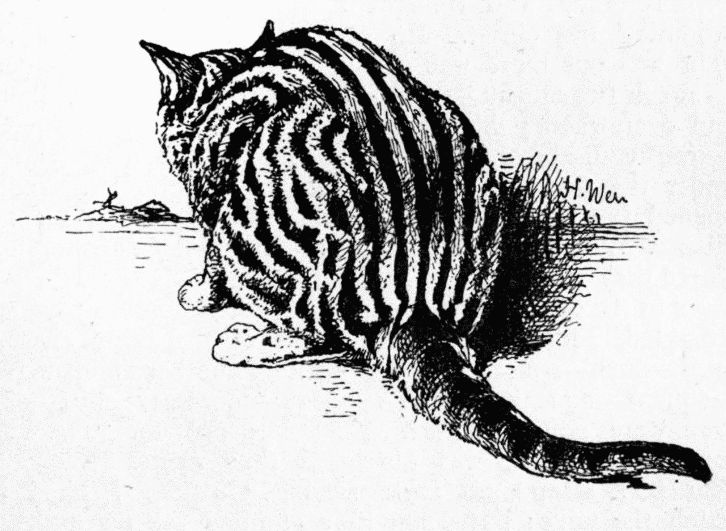
He also remembers his own older blue tabby, known as The Old Lady, and the silver bell she wore. In the book’s illustration list, she is identified as having appeared at the first show without competing. It is a small but important reason not to turn every later retelling into a tidy winner’s story.
The personal detail makes the account warmer. The historical interest lies in a named animal remembered through an object and a picture, alongside the machinery of judging and prizes. Public classification and private affection were present in the same narrative.
What the account supports—and what it does not
- Use the planning details to describe how Weir says the show was assembled.
- Use the named judges to identify the people he records as judging.
- Read the train conversation as part of his retrospective story of skepticism and persuasion.
- Treat the cat-head illustration as a reproduced publicity design, not an exhibition photograph.
Avoid adding a precise crowd size, a complete entry list or an overall champion without consulting a source that actually supports it. Even a familiar historical anecdote can acquire extra certainty as it is repeated. The year and the setting are enough to anchor this introduction.
Why the event still makes a good story
The show did not create people’s affection for cats. Weir’s own explanation depends on that affection already existing. What it offered was an organized public setting in which appearance, comparison and appreciation could be discussed together.
That is the enduring interest of the account. It catches a change in the way familiar companions were presented to an audience, while preserving the practical decisions and personal feelings behind it. We can enjoy the ambition without accepting every Victorian judgment that came with it.
If you open the digitized book, begin with the introductory pages and the first-show chapter. Look at the illustrations as well as the prose. A cat’s head, a remembered bell and a carefully arranged prize schedule tell a more human story than a date on a timeline alone.