01
BEHAVIOR OVERVIEW
What Sphynx caregivers should understand
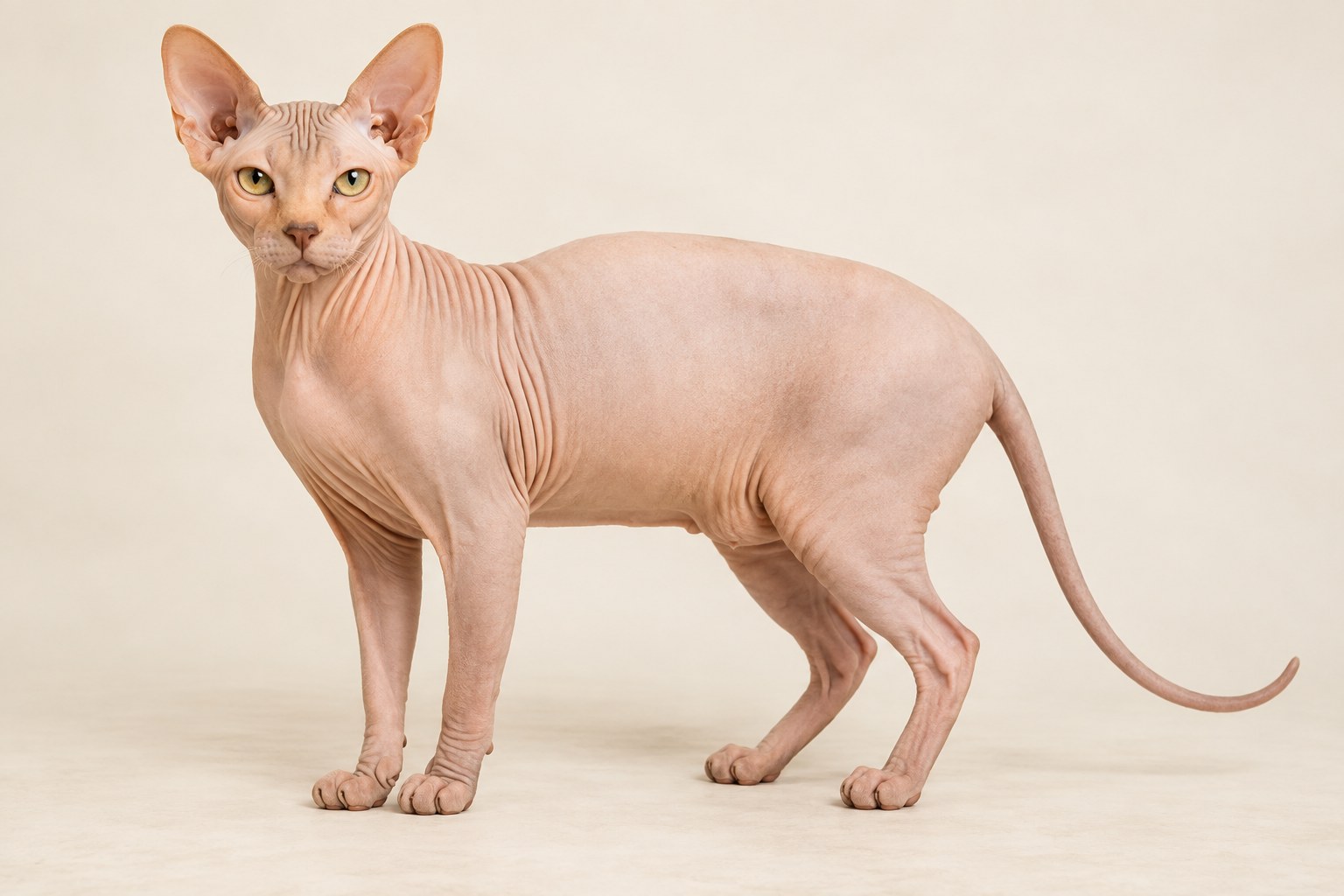
Sphynx guide: This behavior guide uses breed history as background while keeping learning, health, socialization and individual choice at the center. The Sphynx is a medium, muscular pedigreed breed with genetically sparse hair, visible skin pattern, large ears and a warm suede-like feel rather than a truly hairless or hypoallergenic body. The Sphynx coat mutation is distinct from those of Donskoy and Peterbald, and pedigree establishes identity. Fine down, seasonal hair and incomplete whiskers can occur. Lack of a conventional coat does not remove Fel d 1 or guarantee allergy tolerance. Exposed skin requires thoughtful temperature and sunlight management, but the breed should not be portrayed as fragile or dressed continuously without need.
A useful reading of breed temperament
Sphynx cats are often outgoing, active, tactile and persistent seekers of warmth and companionship. Individuals still need consent, quiet retreat and gradual introductions. Provide climbing, hunting play, training, warm beds and social choice. Do not encourage unsafe burrowing in appliances or bedding. New clinginess, restlessness, reduced activity or touch sensitivity can reflect temperature, stress or illness.
Separate tendency from destiny
Breed history can suggest common interests or activity patterns, but behavior emerges from genetics, prenatal conditions, early socialization, learning, health and the present environment. Avoid using a breed label to excuse distress or predict compatibility. Observe the individual cat’s approach, recovery after surprise, play style, touch preferences and ability to rest before deciding what support is needed. For a Sphynx, apply this principle alongside the documented context above and revise the plan whenever the cat’s comfort, health or response changes.
Read consent and distance
A cat may seek proximity without wanting to be picked up or stroked continuously. Look for leaning in, relaxed posture and re-engagement, as well as tail lashing, skin twitching, head turns, freezing or withdrawal. Pause frequently and allow the cat to choose whether contact continues. Respecting small signals prevents escalation and builds more durable trust than testing tolerance. For a Sphynx, apply this principle alongside the documented context above and revise the plan whenever the cat’s comfort, health or response changes.
Use play as a daily conversation
Offer short sessions that imitate searching, stalking, chasing and capturing, then allow a satisfying finish. Move toys away from the cat rather than into the face and rotate styles to identify preferences. Hands and feet should not become prey. Kittens need especially frequent appropriate outlets, while seniors and cats with mobility limits may prefer slower ground-level movement. For a Sphynx, apply this principle alongside the documented context above and revise the plan whenever the cat’s comfort, health or response changes.
Train without force
Reward-based training can teach carrier entry, stationing, nail-care positions, recall and calm examination. Break behavior into easy steps, use small rewards and end while the cat remains engaged. Punishment may suppress warning signals without changing the underlying emotion. When behavior is driven by fear, pain or frustration, environmental and medical causes must be addressed rather than demanding obedience. For a Sphynx, apply this principle alongside the documented context above and revise the plan whenever the cat’s comfort, health or response changes.
Create predictable choice
Predictable meal, play and quiet periods can reduce uncertainty, while choice allows the cat to control distance and location. Provide multiple routes, hiding places and elevated resting sites so no one can trap the cat in a resource area. Novelty is useful only when paired with the option to retreat. Confidence grows through successful experiences, not forced exposure. For a Sphynx, apply this principle alongside the documented context above and revise the plan whenever the cat’s comfort, health or response changes.
Plan multi-pet introductions slowly
Begin with separate territories and scent exchange, then progress through controlled visual access before direct interaction. Each animal needs distributed food, water, litter, resting and scratching resources. Friendly behavior on the first day is not required. Rushing can create long-term conflict that is harder to resolve than a cautious introduction is to manage. For a Sphynx, apply this principle alongside the documented context above and revise the plan whenever the cat’s comfort, health or response changes.
Recognize behavior as health information
Withdrawal, aggression, restlessness, house-soiling, overgrooming, reduced play and changed vocalization can reflect pain or illness. A breed reputation for independence, talkativeness or intensity should never be used to dismiss a new pattern. Record timing and context, arrange veterinary assessment when indicated, and seek a qualified feline behavior professional for persistent problems. For a Sphynx, apply this principle alongside the documented context above and revise the plan whenever the cat’s comfort, health or response changes.
Match enrichment to the individual
An effective plan balances exploration, predatory play, problem-solving, social contact, observation and rest. Introduce one change at a time and watch whether the cat approaches, avoids or becomes over-aroused. Enrichment is not measured by the number of products in the home; it is measured by voluntary use and improved welfare. For a Sphynx, apply this principle alongside the documented context above and revise the plan whenever the cat’s comfort, health or response changes.
Breed-specific practical plan
Offer several brief play cycles, heated and unheated resting choices, covered beds and safe vertical routes. Teach carrier entry, clothing tolerance only if needed, nail care and examination positions with rewards. Check dryers, washers, recliners and blankets before use. If behavior changes, review warmth, skin comfort, cardiac health, pain and social pressure before increasing stimulation or correction.
Life-stage and household review
Build a weekly plan that includes predatory play, foraging, observation, scratching, climbing, rest and low-pressure social contact, then adjust from the cat’s response. More stimulation is not always better; over-arousal and sleep disruption can reduce welfare. Preserve predictable quiet periods and ensure the cat can leave interactions. For kittens and adolescents, reward appropriate outlets before unwanted habits become rehearsed. For adults, maintain novelty through rotation rather than constant accumulation. For seniors, keep familiar routines while lowering physical difficulty and watching for cognitive, sensory or pain-related change. If a problem appears, first describe it precisely, protect safety, check health and modify the environment. Breed personality summaries should generate compassionate questions, never a reason to punish or dismiss an individual.
A repeatable decision framework
A behavior plan becomes more useful when success is defined in observable terms. Instead of “be calmer,” look for eating in the new room, resting with a loose posture, approaching within a chosen distance, using a scratching post or recovering within a few minutes after a sound. Change one factor at a time and keep sessions short enough for success. When visitors arrive, allow retreat and ask guests to ignore the cat until the cat initiates contact. When children participate, teach them to offer toys or treats without cornering, lifting or pursuing. In multi-cat homes, watch for subtle blocking of doorways, litter areas, food and preferred resting sites; absence of fighting does not prove harmony. Add separated resources and visual barriers before conflict becomes dramatic. For travel and veterinary care, train carrier entry and brief confinement on ordinary days. If fear, aggression, compulsive behavior or house-soiling persists, seek qualified help early. The goal is not to erase species-typical behavior but to create safe, acceptable ways for the cat to meet underlying needs.
Practical checkpoints before changing course
Include prevention and recovery in every plan. Before a predictable challenge—building work, guests, travel or a new animal—prepare a safe room, familiar bedding, hiding, elevated space, litter, water and a practiced routine. During the event, reduce exposure instead of repeatedly testing tolerance. Afterward, allow decompression before resuming demanding play or handling. Keep a brief log of trigger, distance, body language, response and recovery time; patterns are more informative than labels such as naughty, dominant or spiteful. Reinforce behavior you want at the moment it occurs, and make unwanted behavior less necessary by meeting the underlying need. Avoid flooding, spray bottles, shouting and physical correction, which can suppress warning signals without resolving fear or frustration. When safety is at risk, separate first and obtain professional support. Progress may be gradual, but consistent environmental changes and humane training usually provide clearer information than escalating punishment.
Keep records that improve decisions
Describe behavior in observable terms: what happened immediately before, what the cat did, how long it lasted and what followed. Avoid labels such as spiteful, dominant or stubborn, which hide the information needed to solve a problem. For this Sphynx guide, documentation also helps separate a true individual pattern from an assumption based on the breed name.
Questions worth taking to a professional
Ask what need the behavior may serve, whether the cat has a safe alternative, what medical causes should be excluded, and which small environmental change can be tested first. Measure progress by recovery and welfare, not silence alone. Bring the cat’s records, photographs or videos when they add context.
Review the plan instead of setting it once
Reassess after household changes, conflict, travel, illness, aging or a loss of predictable routines. A formerly confident cat may need more control and gentler pacing during transition. The strongest breed-specific plan remains flexible, proportionate and centered on the cat’s present quality of life.
What responsible guidance sounds like
Responsible guidance uses words such as may, can and has been reported when evidence is limited. It distinguishes registry descriptions from clinical evidence, identifies when the category itself is disputed, and avoids guaranteeing temperament or health. That standard is especially important for the Sphynx, where identity and documented ancestry determine how much weight any breed association deserves.
02
BREED-SPECIFIC CONTEXT
Temperament tendencies
Sphynxs are often described as intelligent and involved with their people. Some seek lap contact; others prefer to sit nearby or follow household activity. Early socialization, pain, stress and learning history strongly affect behavior. Respect consent signals, give the cat retreat options and avoid forcing interactions to match a stereotype.
03
BREED-SPECIFIC CONTEXT
Activity and exercise
The High activity description is relative. Kittens typically need frequent play, while adults often settle into predictable peaks around dawn and evening. Use sturdy towers, horizontal running space and games that allow stalking, chasing and catching. Monitor breathing and gait during exertion rather than assuming fatigue is normal for the breed.
04
BREED-SPECIFIC CONTEXT
Play and enrichment
Alternate wand toys, rolling prey, tunnels, boxes, food puzzles and short training sessions. Allow the cat to watch and plan rather than waving toys continuously at its face. End with a catch and small food reward when appropriate. Store strings securely after play.
05
BREED-SPECIFIC CONTEXT
Training and learning
Positive reinforcement can teach carrier comfort, recall, stationing, grooming cooperation and simple tricks. Begin in a quiet room, reward small approximations and stop before frustration. Punishment risks fear and damages trust; it does not teach the desired alternative.
07
BREED-SPECIFIC CONTEXT
Vocal behavior
The breed may communicate with meows, trills, chirps and body language, but volume and frequency are individual. Record the context of persistent vocalization. New nighttime calling, especially in a senior cat, can relate to pain, hypertension, thyroid disease, sensory change or cognitive dysfunction.
08
BREED-SPECIFIC CONTEXT
Household environment
Design the home around resources rather than floor area alone. Add stable vertical pathways, multiple scratch orientations, quiet beds, visual barriers and enough litter boxes. Secure screens and balconies. In multi-pet homes, distribute resources so one animal cannot guard every route.
09
BREED-SPECIFIC CONTEXT
Time alone
Time alone depends on age, health, prior experience and the individual. Build predictable departures, accessible water, clean litter boxes, resting sites and safe enrichment into the day. A camera can reveal pacing or distress but does not replace a behavior assessment. Sudden vocalizing, elimination changes, hiding or destructive behavior deserves investigation, including veterinary evaluation when it is new.
10
BREED-SPECIFIC CONTEXT
Potential household fit
The Sphynx can be a rewarding match for people who appreciate companionship balanced with choice and predictable routine. The strongest homes evaluate an individual cat rather than purchasing from a photograph or a list of generalized traits. Ask about the cat’s actual behavior, handling history, recovery after change, play preferences and experience with children or other animals. A household should have time for daily interaction, preventive veterinary care, species-appropriate food, play and environmental choice.
11
BREED-SPECIFIC CONTEXT
When the fit may be difficult
This breed label is not a promise of compatibility. A Sphynx may not suit a home that expects a decorative, maintenance-free pet or cannot provide safe indoor territory, veterinary care and regular engagement. Kittens of any breed can be demanding, and adults may have established preferences. Allergy claims should be treated skeptically: no cat breed is reliably hypoallergenic for every person.
12
THE INDIVIDUAL COMES FIRST
Turn breed context into an individual plan
Temperament is shaped by genetics, early experience, health, learning and the current environment. Treat breed tendencies as context, then respond to the behavior of the individual cat in front of you.
13
USEFUL QUESTIONS
Questions to guide the next conversation
What does relaxed behavior look like for this individual cat?
Which situations trigger avoidance, arousal or frustration?
How can choice, predictability and territory reduce stress?
Could a new behavior indicate pain or illness?
14
SOURCES AND EDITORIAL CARE
How this guide is maintained
Catopedia separates population-level breed context from individualized advice and updates guides when stronger evidence or registry guidance becomes available.
Report a correction or suggest an update →CONTINUE EXPLORING

06
BREED-SPECIFIC CONTEXT
Social needs
Many Sphynxs value regular human contact, but sociability is not permission for constant handling. Provide predictable connection and independent choices. Introduce children through calm floor-level interactions, and teach them to recognize tail lashing, skin twitching, ear rotation and withdrawal.