01
HEALTH OVERVIEW
What Savannah caregivers should understand
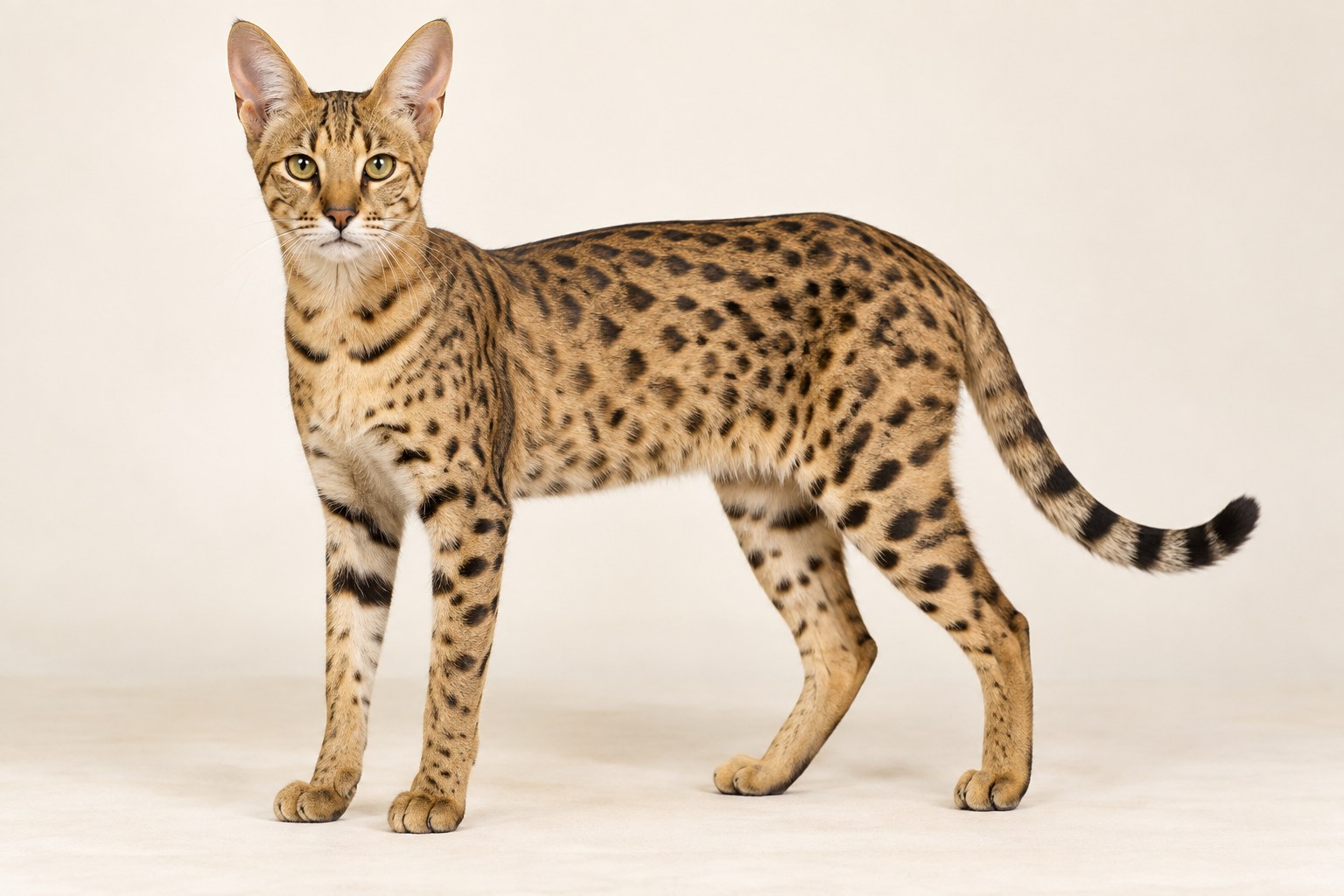
Savannah guide: This health guide translates documented breed context into sensible monitoring without treating ancestry as a diagnosis. The Savannah is a tall, athletic spotted breed developed from domestic cats and the serval, with generation designations that materially affect ancestry, behavior, ownership rules and registry eligibility. Savannah is not one uniform experience. An F1 cat has a serval parent, while later generations have progressively more distant serval ancestry; generation notation and filial status must be documented rather than guessed from appearance. TICA accepts Savannahs for championship from eligible later generations. Ownership restrictions vary by country, state, province and municipality and can change, so legality must be confirmed directly before acquisition, travel or relocation.
Breed-specific health context
Health planning should follow generation, pedigree, family history and the individual rather than the vague label “hybrid vigor.” Ask about cardiac evaluation, fertility history where relevant, joints, teeth, kidneys, gastrointestinal health and longevity. Large ears, long legs and a lean outline are breed traits, not proof of illness, but weight or muscle loss still matters. Never assume a Savannah needs exotic-animal treatment or that ordinary feline symptoms can wait.
Begin with evidence, not a breed label
Breed names can help organize questions, but they cannot determine whether one cat is healthy. A useful assessment combines documented ancestry, family history, previous records, current examination findings and changes observed at home. Screening decisions should be discussed with a veterinarian and matched to the actual line. A negative genetic result addresses only the tested variant; it is not a lifetime health guarantee. For a Savannah, apply this principle alongside the documented context above and revise the plan whenever the cat’s comfort, health or response changes.
Build a reliable baseline
Record normal appetite, thirst, urination, stool, grooming, play, jumping, breathing, sleep and social behavior while the cat is well. Weigh regularly on the same scale when practical and photograph body condition from above and the side. Small changes become easier to recognize when caregivers know what normal looks like for that individual rather than comparing the cat with an idealized breed description. For a Savannah, apply this principle alongside the documented context above and revise the plan whenever the cat’s comfort, health or response changes.
Use preventive visits well
Preventive appointments should cover oral health, heart and lung sounds, eyes, ears, skin, coat, abdomen, joints, muscle condition, body condition, parasite risk and vaccination needs. Frequency depends on age, health and local risk. Bring concise observations and videos of intermittent coughing, altered gait, unusual episodes or litter-box behavior because clinic behavior may not reproduce what happens at home. For a Savannah, apply this principle alongside the documented context above and revise the plan whenever the cat’s comfort, health or response changes.
Understand testing limits
Genetic screening, laboratory work and imaging answer different questions. A DNA panel may identify a specific inherited variant but cannot replace physical examination or prove that every possible inherited condition is absent. Conversely, a reported breed association does not mean every cat requires every available test. The goal is targeted decision-making based on credible evidence and documented ancestry. For a Savannah, apply this principle alongside the documented context above and revise the plan whenever the cat’s comfort, health or response changes.
Protect dental and oral health
Dental disease is common across cats and can quietly affect eating, grooming and behavior. Home observation should include breath, drooling, food dropping, preference for softer textures, facial rubbing and reluctance to have the head touched. Tooth brushing may help when introduced cooperatively, but visible tartar or pain needs professional assessment; cosmetic scraping at home does not treat disease below the gumline. For a Savannah, apply this principle alongside the documented context above and revise the plan whenever the cat’s comfort, health or response changes.
Monitor movement and comfort
Cats often adapt around discomfort by jumping less, choosing lower surfaces, sleeping more or becoming irritable during handling. Those changes should not be dismissed as normal breed temperament or aging. Provide easy routes, nonslip surfaces and accessible resources while arranging assessment. Human pain medication can be dangerous to cats and should never be given without veterinary direction. For a Savannah, apply this principle alongside the documented context above and revise the plan whenever the cat’s comfort, health or response changes.
Recognize urgent changes
Difficulty breathing, collapse, repeated straining without urine, severe weakness, uncontrolled bleeding, seizures, suspected toxin exposure and sudden paralysis require urgent professional help. Persistent vomiting, reduced appetite, marked thirst, weight loss or a sustained behavior change also deserves timely attention. Online breed information should never delay emergency or individualized care. For a Savannah, apply this principle alongside the documented context above and revise the plan whenever the cat’s comfort, health or response changes.
Plan across the lifespan
Kittens need developmentally appropriate examinations, parasite control, vaccination planning and gentle handling practice. Adults benefit from trend monitoring rather than waiting for obvious illness. Senior cats may need more frequent evaluation, blood pressure assessment, laboratory screening and home modifications. The schedule should follow the individual, not a fixed assumption about breed longevity. For a Savannah, apply this principle alongside the documented context above and revise the plan whenever the cat’s comfort, health or response changes.
Breed-specific practical plan
Request the pedigree, generation calculation, registration documents and original health records. Ask which tests were selected and why, how older relatives fared and whether the veterinarian is comfortable treating the cat. Establish normal weight, muscle, gait, breathing, appetite and stool. Open-mouth breathing, collapse, repeated vomiting, inability to urinate or sudden weakness requires urgent care, not hybrid-specific online advice.
Life-stage and household review
Life-stage planning adds context to breed discussions. For kittens, confirm identification, preventive care, growth and any testing relevant to documented parentage. During adulthood, follow trends in weight, muscle, mouth, movement and behavior instead of relying on an annual snapshot. For seniors, make resources easier to reach and discuss whether examination frequency, blood pressure, laboratory screening or pain assessment should change. In every stage, separate three ideas: a condition reported in a population, a risk supported in a documented family and a diagnosis in the individual. They are not interchangeable. When selecting a breeder, request interpretable records and ask what happens if a health problem appears after placement. When adopting, work from the records available without assuming absence of documentation means either disease or perfect health.
A repeatable decision framework
A practical monitoring calendar can prevent breed information from becoming either alarmist or forgettable. Choose a monthly home check for weight trend, coat, nails, mouth observation, movement and any known area of concern; record only findings that can be described consistently. Before a preventive appointment, summarize changes and list the questions that would alter care. Afterward, record the clinician’s findings, the purpose of each test and when follow-up is actually due. Avoid purchasing broad panels repeatedly without understanding what they measure. Screening has greatest value when a result can guide breeding, diagnosis, surveillance or treatment. It has less value when a vague result creates worry without an evidence-based action. Insurance or emergency-fund planning is also part of health preparation, particularly before a condition is documented. Keep emergency clinic details, toxin-control information and transport equipment accessible. Finally, review claims encountered online by checking whether they refer to the same breed population, whether the evidence comes from a case report or larger study, and whether the source distinguishes association from causation. This disciplined approach protects the individual cat from both complacency and unnecessary intervention.
Practical checkpoints before changing course
Use a simple escalation rule so observations lead to appropriate action. Emergency signs—difficulty breathing, collapse, repeated unproductive straining, major trauma, seizures, severe bleeding or suspected toxin exposure—need immediate professional direction. New but stable changes deserve a prompt appointment rather than weeks of online experimentation. Mild observations that resolve can still be recorded and mentioned at routine care. Never give human medicine unless a veterinarian has prescribed the exact product and dose for this cat. When comparing advice, favor veterinary organizations, peer-reviewed research, recognized registry documentation for identity questions and sources that state their limitations. Save test reports, imaging summaries and discharge instructions in one place, and ask for plain-language explanations of uncertain findings. A second opinion can be reasonable for complex decisions. The objective is neither maximum testing nor minimum intervention: it is timely, proportionate care based on the individual cat, credible evidence and informed discussion with the veterinary team.
Keep records that improve decisions
Keep laboratory reports, genetic results, imaging, medication history, vaccination records, dental charts and family information together. Record the precise test and variant rather than writing only “clear.” This prevents an old result from being given broader meaning than it has. For this Savannah guide, documentation also helps separate a true individual pattern from an assumption based on the breed name.
Questions worth taking to a professional
Ask which findings are established for this individual, which are only possible breed associations, what monitoring would change management, and what symptoms require urgent attention. A good plan explains both action and uncertainty. Bring the cat’s records, photographs or videos when they add context.
Review the plan instead of setting it once
Revisit the plan after any diagnosis, major weight change, reproductive decision, move, adoption or transition into senior life. Health guidance is useful only when it changes with the cat. The strongest breed-specific plan remains flexible, proportionate and centered on the cat’s present quality of life.
What responsible guidance sounds like
Responsible guidance uses words such as may, can and has been reported when evidence is limited. It distinguishes registry descriptions from clinical evidence, identifies when the category itself is disputed, and avoids guaranteeing temperament or health. That standard is especially important for the Savannah, where identity and documented ancestry determine how much weight any breed association deserves.
02
BREED-SPECIFIC CONTEXT
General health context
Savannah health planning should include hypertrophic cardiomyopathy surveillance, orthopedic and mobility assessment, dental care, gastrointestinal history and careful monitoring of growth and body condition. Early-generation hybrid welfare and behavior require specialized expertise. Routine vaccines, anesthesia and nutrition should be managed by a veterinarian familiar with the individual rather than internet claims that hybrids need fundamentally exotic protocols. A breed association describes risk at a population level; it cannot diagnose an individual. Good care includes a baseline veterinary examination, vaccination and parasite plans tailored to location and lifestyle, dental monitoring, healthy body condition and prompt attention to change. Responsible sources disclose health information instead of promising that a line is completely free of disease.
03
BREED-SPECIFIC CONTEXT
Potential hereditary conditions
Savannah health planning should include hypertrophic cardiomyopathy surveillance, orthopedic and mobility assessment, dental care, gastrointestinal history and careful monitoring of growth and body condition. Early-generation hybrid welfare and behavior require specialized expertise. Routine vaccines, anesthesia and nutrition should be managed by a veterinarian familiar with the individual rather than internet claims that hybrids need fundamentally exotic protocols.
Testing must be interpreted in context. A clear DNA result covers only the named variant; an imaging result describes one point in time. Ask how a breeder uses results across a family and what happens when a cat develops a significant condition.
04
BREED-SPECIFIC CONTEXT
Breed-appropriate screening
Discuss serial cardiac screening and family history; orthopedic, gait and mobility assessment; complete veterinary and reproductive history; generation and pedigree verification; blood typing, nutrition review and genetic-diversity planning. Request copies rather than accepting “health tested” as a complete answer. Verify who performed each test, when it was done and whether repeat testing is appropriate. Kittens should also receive routine examinations and age-appropriate preventive care.
05
BREED-SPECIFIC CONTEXT
Responsible breeding considerations
Responsible programs balance genetic diversity, health, behavior and structure. They keep complete records, disclose relevant results, raise kittens in a clean socially rich environment, use written agreements and remain available throughout the cat’s life. They do not guarantee a disease-free future or produce kittens to satisfy color trends alone.
06
BREED-SPECIFIC CONTEXT
Weight and body-condition considerations
Dense coats or a substantial build can make excess weight easy to miss. Learn to assess ribs, waist and abdominal contour with veterinary guidance, and record weight trends rather than reacting to one number. Unexplained gain or loss should be investigated. Portion control, play and accessible climbing help, but pain or disease must be addressed before simply increasing exercise.
07
BREED-SPECIFIC CONTEXT
When to consult a veterinarian
Seek veterinary advice for breathing difficulty, collapse, repeated vomiting, inability to urinate, severe injury, toxin exposure or marked weakness; these may be emergencies. Arrange a timely visit for persistent appetite, thirst, litter-box, mobility, skin, coat or behavior changes. Online breed information is general education and never a substitute for an examination by a veterinarian who knows the cat.
08
THE INDIVIDUAL COMES FIRST
Turn breed context into an individual plan
Age, sex, ancestry, environment, preventive care and chance all influence health. Keep a baseline record of appetite, weight, mobility, elimination, grooming, sleep and social behavior so changes are easier to recognize.
09
USEFUL QUESTIONS
Questions to guide the next conversation
Which health screenings are relevant to this cat’s documented family line?
Which changes would justify a prompt veterinary appointment?
How often should weight, dental health and mobility be reassessed?
What records should follow the cat into a new home?
10
SOURCES AND EDITORIAL CARE
How this guide is maintained
Catopedia separates population-level breed context from individualized advice and updates guides when stronger evidence or registry guidance becomes available.
Report a correction or suggest an update →CONTINUE EXPLORING