01
NUTRITION OVERVIEW
What Pixie-Bob caregivers should understand
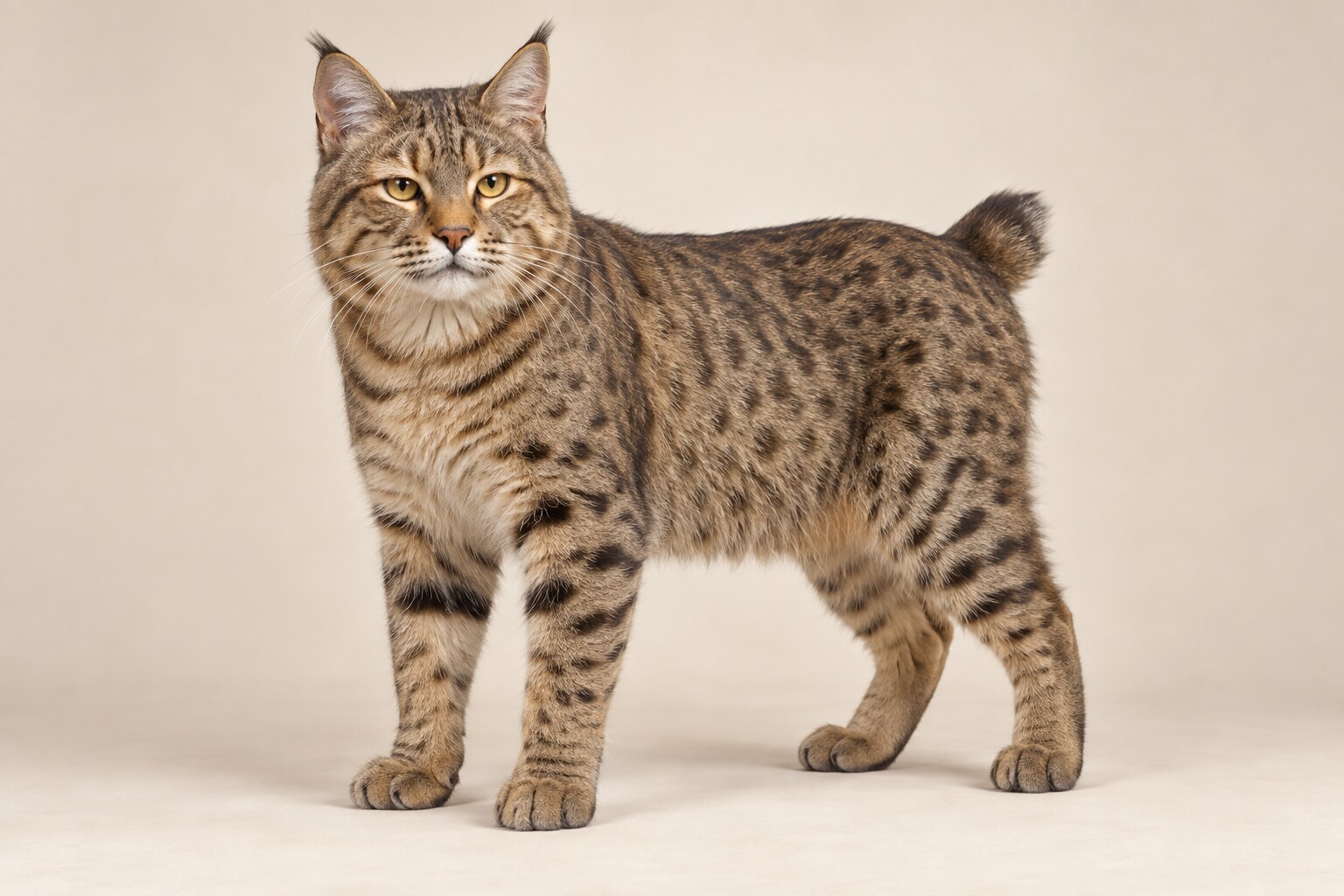
Pixie-Bob guide: This nutrition guide explains where breed context is useful—and where body condition, life stage and health must take priority. The Pixie-Bob is a fully domestic, muscular pedigreed breed developed to resemble the North American bobcat, available in shorthaired and longhaired forms and uniquely permitted polydactyly under the TICA standard. The Pixie-Bob’s wild appearance does not establish bobcat ancestry, and responsible descriptions should not market it as a wild hybrid. Pedigree establishes identity. Tail length and shape vary, and TICA notes that the tail should remain flexible and move naturally. Polydactyl feet can have unequal toe counts; every digit requires functional assessment and routine nail care.
Breed context without a breed-diet myth
A large, muscular appearance does not require raw food, supplements or unrestricted calories. Feed complete food appropriate to life stage and health, measure portions and distinguish muscle from excess fat through hands-on scoring. Count training treats and maintain lean condition to reduce avoidable orthopedic load. No diet changes tail length, toe count or authenticates claimed wild ancestry.
Start with nutritional adequacy
The foundation is a food labeled complete and balanced for the cat’s life stage under the standards used in the relevant market. Complementary foods, treats and toppers are not substitutes for a complete diet. Breed marketing on a package does not by itself demonstrate that a formula is superior. Ingredient lists also cannot reveal digestibility, quality control or whether a manufacturer employs qualified nutrition expertise. For a Pixie-Bob, apply this principle alongside the documented context above and revise the plan whenever the cat’s comfort, health or response changes.
Feed the individual in front of you
Estimate energy needs, then adjust from real outcomes. Age, neuter status, activity, environment, body size, illness and individual metabolism matter more than a generic breed portion. Measure food consistently and reassess every few weeks after a change. The correct amount is the amount that supports an appropriate body and muscle condition without persistent hunger, weight drift or gastrointestinal problems. For a Pixie-Bob, apply this principle alongside the documented context above and revise the plan whenever the cat’s comfort, health or response changes.
Use body and muscle condition together
A dense coat or sturdy frame can conceal fat gain, while aging can cause muscle loss even when body weight looks stable. Feel the ribs, waist, spine, shoulders and hindquarters rather than relying only on appearance. Ask the veterinary team to record body-condition and muscle-condition scores so changes can be followed over time using the same scale. For a Pixie-Bob, apply this principle alongside the documented context above and revise the plan whenever the cat’s comfort, health or response changes.
Support normal feeding behavior
Many cats benefit from several small meals and opportunities to search or work gently for part of the ration. Puzzle feeders must match skill and mobility; a difficult device can create frustration or reduce intake. In multi-cat homes, separate feeding stations prevent competition and make appetite measurable. Do not assume shared bowls reveal how much each cat eats. For a Pixie-Bob, apply this principle alongside the documented context above and revise the plan whenever the cat’s comfort, health or response changes.
Make hydration easy
Provide fresh water in multiple quiet places, separate from litter and often separate from food. Bowl material, width, depth and location influence preference; some cats also enjoy a fountain. Wet food may increase water intake for suitable individuals, but no single format is mandatory for every healthy cat. Changes in thirst or urine volume require assessment rather than simply adding water. For a Pixie-Bob, apply this principle alongside the documented context above and revise the plan whenever the cat’s comfort, health or response changes.
Count treats and extras
Treats, training rewards, dental products, supplements, table food and medication vehicles all contribute calories and nutrients. Keep extras modest—commonly no more than about ten percent of daily calories unless a veterinary nutrition plan says otherwise. Reducing the complete food too far to accommodate extras can unbalance the overall diet even when body weight remains stable. For a Pixie-Bob, apply this principle alongside the documented context above and revise the plan whenever the cat’s comfort, health or response changes.
Change diets gradually and deliberately
Transition over several days or longer when appropriate, mixing increasing amounts while monitoring appetite, stool and vomiting. Cats should not be forced into prolonged fasting to accept a new food. A cat eating markedly less, refusing food or losing weight needs prompt advice because reduced intake can become medically serious. Therapeutic diets should be used for the diagnosed individual and monitored. For a Pixie-Bob, apply this principle alongside the documented context above and revise the plan whenever the cat’s comfort, health or response changes.
Be cautious with supplements and trends
More nutrients are not automatically better. Supplements can duplicate fortified food, alter mineral balance, interact with treatment or add substantial calories. Raw animal products introduce nutritional and infectious risks, while homemade diets require formulation by a properly qualified veterinary nutrition professional. Use evidence, manufacturer transparency and the cat’s medical needs—not online popularity—to guide decisions. For a Pixie-Bob, apply this principle alongside the documented context above and revise the plan whenever the cat’s comfort, health or response changes.
Breed-specific practical plan
Weigh meals and treats, record body and muscle condition monthly and adjust for life stage and activity. Use part of the ration for training or floor-level searches. Avoid calcium, growth and joint supplements without a defined indication. If activity falls or weight rises, investigate pain and environment before imposing severe restriction. Therapeutic diets should match an individual diagnosis.
Life-stage and household review
Life-stage labels are a starting point, not the entire assessment. Growth, pregnancy, lactation, neutering, indoor living, heavy activity, disease and senior muscle loss can substantially change needs. Compare products by nutritional adequacy, manufacturer transparency, calorie density and the cat’s response—not by a breed picture on the package. Keep an emergency record of the exact food and amount so another caregiver can reproduce the routine. If weight management is needed, preserve essential nutrients by using an appropriate calorie-controlled plan rather than simply shrinking an unsuitable ration indefinitely. Recheck weight and condition during change. Appetite is also a health signal: a normally eager cat eating less, or a cat becoming suddenly ravenous, should prompt investigation rather than an automatic portion adjustment.
A repeatable decision framework
A useful feeding audit answers concrete questions. What is the food’s full name and calorie density? How many grams or cans are offered in twenty-four hours? How much remains? Which treats, supplements and shared foods are added? Does every household member know the plan? Is one pet stealing from another? Review the answers whenever weight or appetite changes. Automatic feeders can distribute meals, but they do not replace observation and may need separate microchip access in multi-cat homes. Food puzzles should dispense reliably and be cleaned before residue becomes rancid. Store dry food sealed in its original bag inside a container so lot and expiry information remain available; refrigerate opened wet food according to manufacturer directions. Avoid sudden restriction in an overweight cat and never allow a cat to stop eating in pursuit of weight loss. Sustainable nutrition combines adequate essential nutrients, appropriate energy, hydration opportunities, normal feeding behavior and regular reassessment. No breed-specific marketing claim should outrank those fundamentals.
Practical checkpoints before changing course
Before changing food, define the reason and the result that would count as improvement. For weight management, use measured weight and body-condition trend. For suspected intolerance, work with a veterinarian on a sufficiently strict and appropriately timed trial rather than cycling through flavors. For urinary, renal, gastrointestinal or allergic disease, confirm that the chosen product matches the diagnosis and feeding instructions. Transition gradually when medically appropriate, while watching intake, stool, vomiting, comfort and acceptance. Do not let a cat go without adequate food simply to force a preferred diet. Keep water in several clean locations and test bowl materials and placement if intake seems poor. Reassess after neutering, activity changes, illness, medication or a move. Nutrition succeeds when the cat consistently consumes a complete appropriate diet in an amount that supports healthy condition and when the household can maintain the plan accurately over time.
Keep records that improve decisions
Record the exact product, formulation, amount offered, leftovers, treats, supplements, appetite, stool, vomiting, weight and body-condition trend. “One cup” or “one can” is not precise enough when products and package sizes differ. For this Pixie-Bob guide, documentation also helps separate a true individual pattern from an assumption based on the breed name.
Questions worth taking to a professional
Ask whether the food is complete for the life stage, how calorie recommendations were calculated, what body-condition target is appropriate, and which changes require veterinary supervision. Marketing categories are not a substitute for nutritional assessment. Bring the cat’s records, photographs or videos when they add context.
Review the plan instead of setting it once
Review intake after neutering, growth, activity changes, illness, medication, pregnancy, lactation and aging. Avoid waiting for a dramatic weight change before adjusting a plan. The strongest breed-specific plan remains flexible, proportionate and centered on the cat’s present quality of life.
What responsible guidance sounds like
Responsible guidance uses words such as may, can and has been reported when evidence is limited. It distinguishes registry descriptions from clinical evidence, identifies when the category itself is disputed, and avoids guaranteeing temperament or health. That standard is especially important for the Pixie-Bob, where identity and documented ancestry determine how much weight any breed association deserves.
02
BREED-SPECIFIC CONTEXT
Feeding considerations
Feed a complete and balanced diet appropriate to life stage, using the package guide only as a starting point. Measure portions, count treats and reassess body and muscle condition regularly. Growth, neuter status, activity, illness and pregnancy can change energy needs substantially. Food puzzles can slow eating and add hunting-like activity, but weight loss diets and therapeutic foods should be planned with a veterinarian.
03
BREED-SPECIFIC CONTEXT
Weight and body condition
Dense coats or a substantial build can make excess weight easy to miss. Learn to assess ribs, waist and abdominal contour with veterinary guidance, and record weight trends rather than reacting to one number. Unexplained gain or loss should be investigated. Portion control, play and accessible climbing help, but pain or disease must be addressed before simply increasing exercise.
04
BREED-SPECIFIC CONTEXT
Energy expenditure
The Pixie-Bob benefits from daily interactive play, climbing and problem solving matched to the individual. does not mean nonstop exertion. Several short, successful sessions usually work better than one long session. Combine wand play, climbing, food searches and training; finish chase games with something the cat can catch. Increase difficulty gradually, protect growing joints, and adapt activities for senior cats, pain or disability. A sudden fall in activity can be a health signal rather than laziness.
05
BREED-SPECIFIC CONTEXT
Food and dental-health context
Dental disease is common across cats. Acclimate the cat gradually to mouth handling and, when feasible, brushing with feline toothpaste. Human toothpaste is unsafe. Bad breath, drooling, dropping food, chewing on one side, pawing at the mouth or reduced appetite warrants veterinary attention. Professional dental assessment is not replaced by treats, water additives or visually clean front teeth.
06
BREED-SPECIFIC CONTEXT
When veterinary nutrition guidance matters
Seek veterinary advice for breathing difficulty, collapse, repeated vomiting, inability to urinate, severe injury, toxin exposure or marked weakness; these may be emergencies. Arrange a timely visit for persistent appetite, thirst, litter-box, mobility, skin, coat or behavior changes. Online breed information is general education and never a substitute for an examination by a veterinarian who knows the cat.
07
THE INDIVIDUAL COMES FIRST
Turn breed context into an individual plan
Calorie needs and food tolerance cannot be predicted from breed alone. Use body and muscle condition, life stage, activity, health and veterinary advice to adjust portions and food choices.
08
USEFUL QUESTIONS
Questions to guide the next conversation
Is the current food complete and balanced for this life stage?
What daily calorie range and body-condition target are appropriate?
How should treats and food enrichment fit into the total ration?
Which symptoms mean a diet change needs veterinary supervision?
09
SOURCES AND EDITORIAL CARE
How this guide is maintained
Catopedia separates population-level breed context from individualized advice and updates guides when stronger evidence or registry guidance becomes available.
Report a correction or suggest an update →CONTINUE EXPLORING