A small shelf, rather than a reading challenge
Some fictional cats are wonderfully recognizable even when they do impossible things. They can get caught in a household’s plans, sail away with an unexpected companion or answer a perfectly reasonable question with an unsettling piece of logic. Their appeal is partly feline and partly the pleasure of the world around them.
This selection brings together a short illustrated tale, a poem and an encounter from a longer novel. Choose one for a quiet afternoon, or read them across several days. The links lead to digitized original texts, so you can follow the details beyond the familiar titles. There is no need to complete the list in order.
The Tale of Tom Kitten: when the outfit has other plans
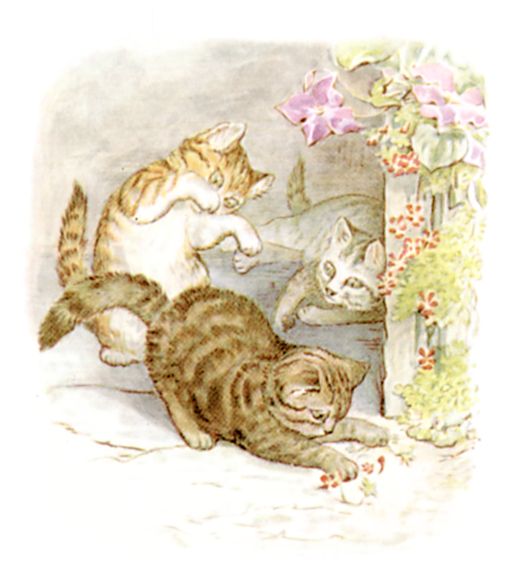
Beatrix Potter’s The Tale of Tom Kitten, first published in 1907, begins with a household preparing for company. Mrs. Tabitha Twitchit dresses Mittens, Moppet and Tom for the occasion. The kittens, their clothes and the garden soon cease to cooperate with the intended arrangement.
The comedy is wonderfully physical. Buttons, pinafores and a garden wall become part of an escalating muddle, with the Puddle-Ducks making matters still less dignified. Potter’s pictures carry details that a plot summary cannot replace. Notice the gap between the careful adult preparations and the kittens’ much less orderly afternoon.
One way to read the story is as a joke about appearances: the more important it becomes to look respectable, the harder respectability is to maintain. That is our reading of the scene, rather than a claim that the book supplies a single lesson. Its characters belong to a fictional household, and the clothes are part of the comedy, not a suggestion for dressing a real cat.
The Owl and the Pussy-Cat: let the voyage be a voyage
Edward Lear’s The Owl and the Pussy-Cat offers a different kind of pleasure. Its unlikely travelers take to the sea, find a ring and marry with the help of a turkey. The poem treats its extraordinary arrangements with such ease that explaining them would spoil much of the fun.
Read it aloud and listen to the movement between longer lines and repeated phrases. The sound can carry you forward before you pause to think about the picture being made. Details such as the ring, the food and the invented spoon belong to a world that feels complete without behaving like an ordinary one.
The Pussy-Cat is a participant in an adventure and a romance, not a miniature case study of feline behavior. That freedom is part of the poem’s charm. You can enjoy the pairing, the rhythm and the final scene without needing a practical reason why these two companions chose each other.
The Cheshire Cat: a question that changes shape
In chapter six of Lewis Carroll’s Alice’s Adventures in Wonderland, Alice meets the Cheshire Cat and asks about the way forward. The conversation turns on a simple difficulty: advice about where to go depends on what destination she has in mind. An apparently helpful guide becomes another source of Wonderland uncertainty.
The Cat’s appearances and disappearances make the exchange even stranger. An ordinary feature—a smile—becomes something that can remain after the rest of the animal has gone. Carroll takes a familiar expression and lets the imagination separate it from the body that usually carries it.
For this reading, linger over the conversation rather than racing toward the next famous scene. Alice’s attempts to be sensible are part of the comedy. The Cat does not have to be a dependable adviser to be an excellent character; his talent is for making an ordinary question newly peculiar.
Three very different kinds of cat company
Choose Tom Kitten for illustrated domestic comedy, Lear’s poem for rhythm and cheerful impossibility, or Alice’s encounter with the Cheshire Cat for playful questions about logic. Each offers a different kind of company for a quiet afternoon.
These are invitations, not instructions for arriving at the right interpretation. You may remember a different detail, find one character irritating or prefer the pictures to the prose. A small reading list should leave room for your own response.
If you are reading together, leave space for a pause
Read a little, look at the illustrations where available and let the listener decide what caught their attention. A question such as “Which detail did you notice?” can open a conversation without turning the afternoon into a test of comprehension.
Preview older works before sharing them with children. Potter’s tale includes the mother smacking the kittens, and older stories can contain behavior or assumptions a present-day reader may want to discuss. You can acknowledge that directly while keeping fiction separate from how people and animals should be treated.
If a passage or image is not right for your group, choose another part of the list. Familiarity and classic status do not oblige every reader to enjoy the same scene. The point is a pleasant shared encounter with a book.
Keep the part that makes you want to return
After reading, save a link or write down the title and the scene you liked. You might return for Potter’s careful illustrations, Lear’s sound or Carroll’s habit of making a confident answer wobble. Remembering one particular pleasure is enough.
Try returning later without demanding the same reaction. A story remembered from childhood may look different when you notice the adult characters, the pacing or an illustrator’s small joke. That change is part of what makes familiar books worth revisiting.
Then let the real cat beside you remain a real cat. The fictional ones can manage the voyages, disappearing acts and garden-wall disasters. An ordinary afternoon with a book needs only a comfortable place, a little time and something that makes you want to turn the page.