Give the cat a moment before reading the life story
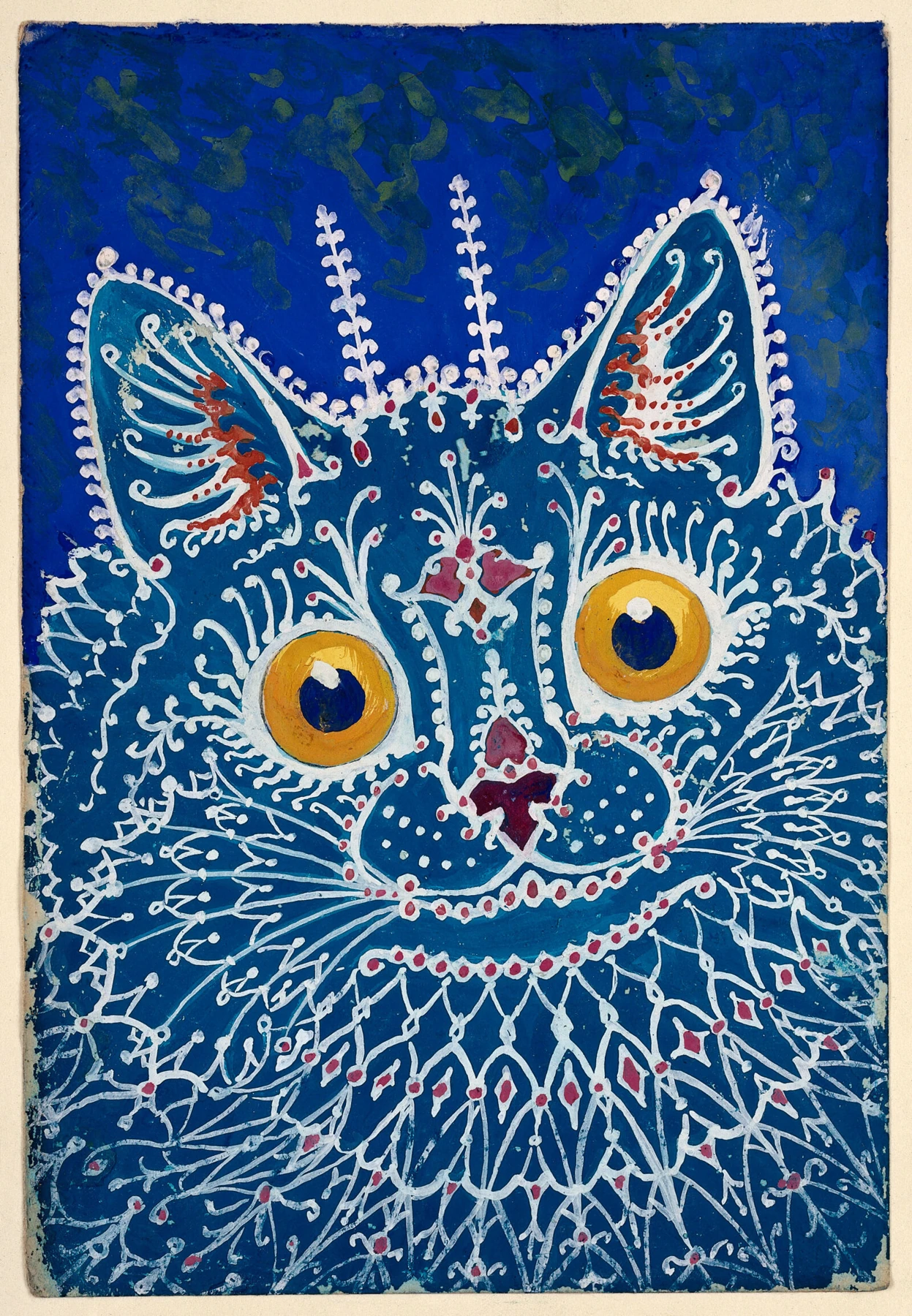
Begin with the face. The eyes are easy to find; the rest of the cat seems to arrive through pattern. White lines curve across turquoise fur against a deeper blue ground, making a familiar animal feel almost architectural.
The work is Norman, a gouache by Louis Wain in Wellcome Collection. Its catalogue gives a creation range of 1925–1939, rather than a single exact year. The sheet is small: 18.5 by 12.2 centimetres. Seen on a large screen, it is worth remembering that intimate physical scale.
You can enjoy the image before knowing anything about its maker. Then open the collection record and let it sharpen your looking. The record supplies material, dimensions and a date range. Your response to the face remains your own.
An illustrator whose cats could carry a whole scene
Louis Wain lived from 1860 to 1939. Bethlem Museum of the Mind describes his early work across different subjects and the popularity of his cat pictures from the 1880s to the First World War. Cats became the recurring figures through which many people encountered his work.
That recurrence is part of the pleasure. A cat can be recognizable while the surrounding language changes: a domestic observation, a comic social occasion, an increasingly elaborate arrangement of colour and line. You do not have to choose one version as the only authentic Wain.
Try keeping two questions separate as you browse. What does the collection tell you about this object? And what does the picture invite you to notice? That distinction makes room for delight without turning a lively interpretation into an unsupported historical claim.
Look for the human joke inside the cat picture
The V&A’s illustrated introduction offers a useful route into Wain’s comic world. It shows cats taking part in human-style occasions and activities, including social introductions, a seaside scene and a musical performer.
Look at the arrangement of a group before concentrating on its whiskers. Who seems to be waiting? Who occupies the centre? Which gesture would remain recognizable if the characters were people? These are viewing prompts, not fixed explanations of what every figure means.
Then ask what makes the scene remain feline. An ear, a paw or the shape of a face may keep pulling it back from an ordinary human cartoon. The amusement lives in that crossing: enough human behaviour to recognize a situation, enough cat to make it wonderfully strange.
Let a caption add precision, not take over the picture
One V&A example, A Kitten’s Christmas Party, consists of original drawings for an illustration published in the Christmas number of the Illustrated London News in 1886. The museum also discusses designs made for picture postcards and a newspaper series about a cat’s nine lives.
Those details change how you look. A drawing prepared for print belongs to a different viewing situation from a picture made to hang alone. Think about how a reader might encounter a busy scene on a page, or a smaller joke on a postcard passed from one person to another.
Do not assume the image you see online has the same dimensions, colour or surface as the object. Read the material and size when they are supplied. If a catalogue says “about” or gives a range, preserve that uncertainty when telling someone else about the work.
Return to Norman and follow one line
Now return to the blue cat. Choose a patch of white pattern near the face and follow it with your eyes. Does it lead towards an ear, fold around a cheek or interrupt your sense of fur? There is no requirement to see it in the same way twice.
Wellcome’s description compares the white patterning with Gothic architectural ornament. Use that as an invitation to look, not as a puzzle with one solution. You might notice pointed forms and repeated curves before you notice the body as a whole. Step back from the screen and see which features remain strongest.
The catalogue also records “Norman” in pencil on the reverse and explains that the present title comes from wording on the object. Even a small fact about the back of a painting can change its presence: an intricate cat becomes a particular named work, held and described by a collection.
Do not turn a sequence of pictures into a diagnosis
Wain’s later life and hospital care are part of his biography. They should not become a shortcut that reduces every colourful cat to evidence of a condition. An image is not a clinical record, and a dramatic arrangement of pictures on the internet is not necessarily an established chronology.
The V&A specifically notes that links between increasingly elaborate images and Wain’s mental state remain inconclusive, in part because many works are undated. Bethlem’s biography also records that he continued drawing during his hospital years.
For a viewer, the practical habit is simple: keep a work’s documented date separate from a story someone has built around it. You can discuss colour, repetition and expression with care, without pretending the picture reveals the artist’s thoughts or supplies a diagnosis.
Make a three-image viewing session
Choose one linked V&A group scene, one image focused on a single comic performer and Norman. Open their museum information beside them. Give each image a few unhurried minutes rather than scrolling through dozens of thumbnails.
- Describe what is visible in plain language, without guessing at a backstory.
- Read the object information and add only details it supports.
- Write one personal observation, clearly as your own response.
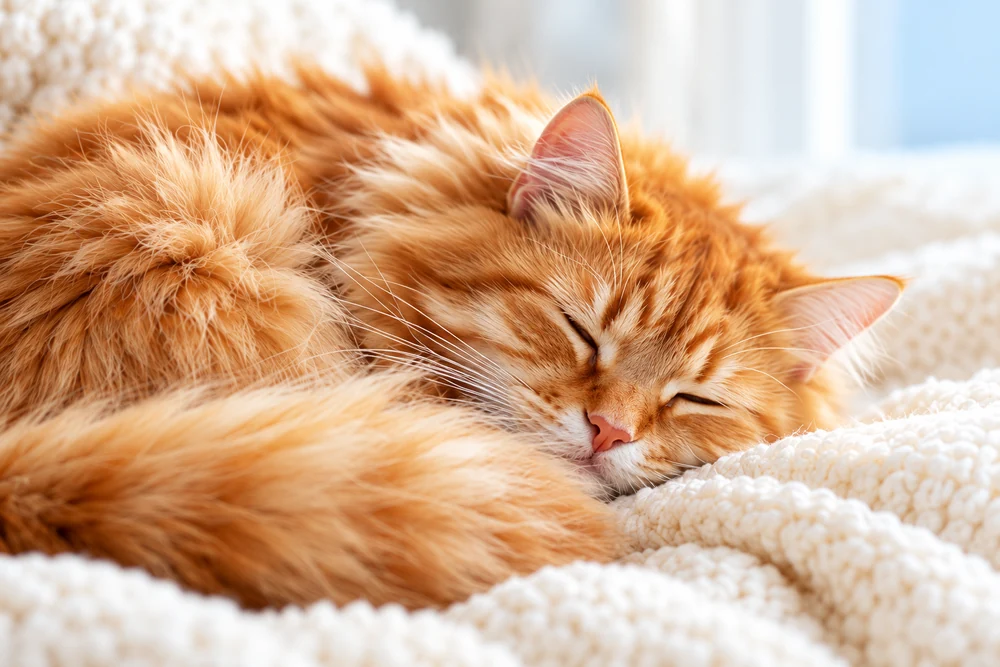
You might discover that you prefer the bustling compositions to the patterned face, or the reverse. You might also recognize a familiar expression from your own cat. Neither response needs to become a claim that a painted cat and a living animal are thinking the same thing.
Keep the credit with the image
The lead artwork here is reproduced from Wellcome Collection under its Public Domain Mark. The museum record supplies the source and rights information. Other websites and collections may apply different terms to their images, so check the particular item before downloading or reusing it.
Save the collection link with any notes you make. It preserves the title, attribution and date range more reliably than a screenshot detached from its caption. If you share the work, include that route back to the object.
Then leave a little room for simply liking it. A cat article can offer a useful next step without being a task to complete. Here the next step is another look: at a small blue painting, a wonderfully crowded party, or the real cat who has just walked between you and the screen.