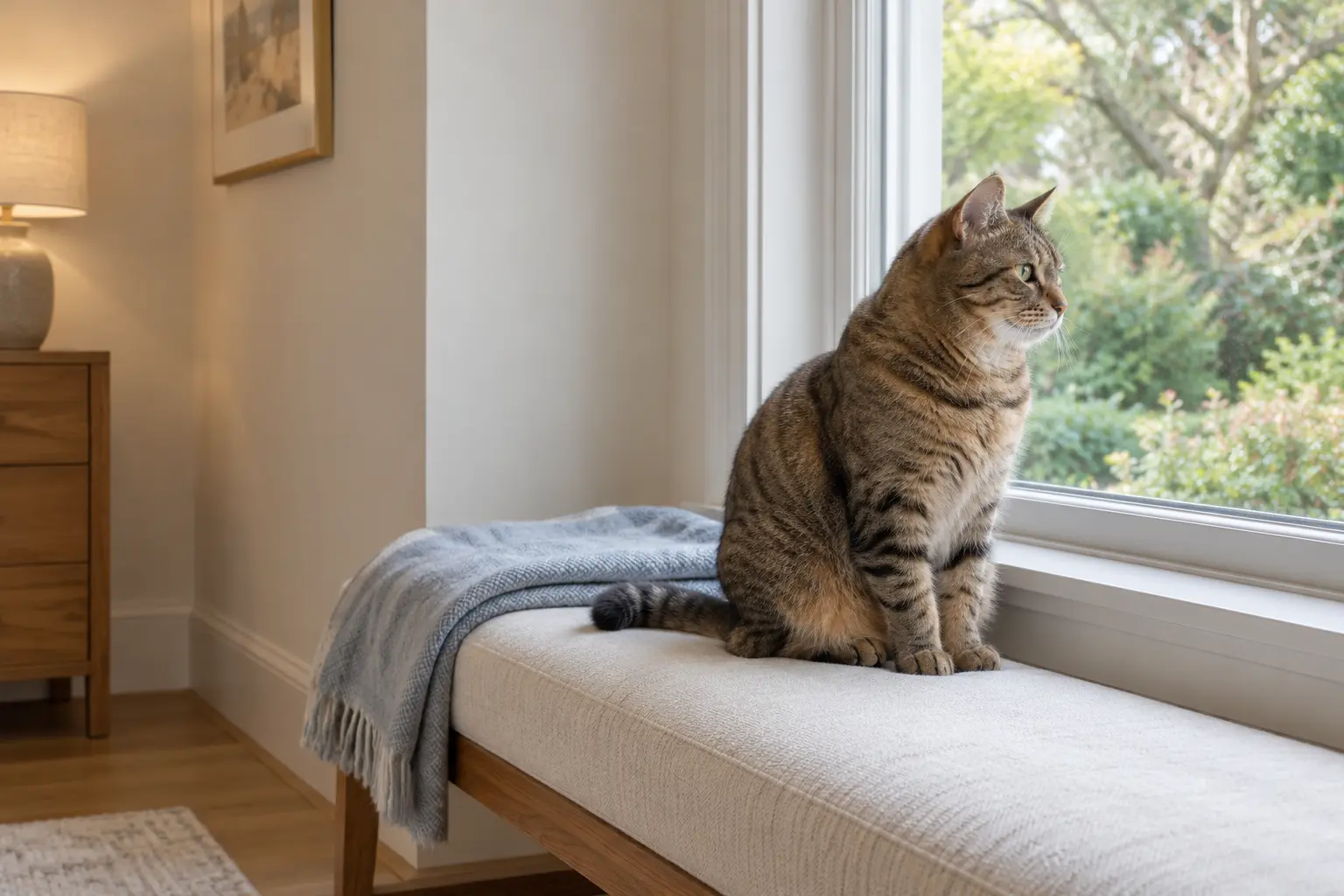
Start with the view your cat already chooses
The best starting point may be the place your cat has already found: a patch of floor beside the patio door, the end of a sofa or a low bench in the afternoon light. Before buying a perch, watch that spot. Notice how your cat reaches it, where they put their feet and whether they can leave without crossing a busy walkway.
This weekend project is deliberately small. You are creating one optional place to watch and rest, not redesigning the whole room or asking your cat to perform. A successful result might be a familiar chair moved a little closer to a closed window.
Make security the first design decision
Keep the window securely closed while you plan and test the spot. Open windows and balconies can present fall risks; tilt-opening windows can trap cats. Do not treat an ordinary insect screen as a guarantee of containment. If you need ventilation, get an appropriate secure barrier assessed for that window before giving your cat access. See the Cats Protection safety guidance in the sources below.
Check the area for dangling blind cords, loose fabric loops, electrical cables and objects that could topple. Place cords out of reach. Keep the resting surface away from a hot radiator or other heat source, and avoid placing breakable decorations on the route.
Three starting arrangements to compare
These are planning examples, not tested furniture specifications. Choose a setup you can secure and maintain, and keep the window itself closed during the trial.
- In a small apartment, try a broad, low bench beside a closed window. Leave the doorway and everyday walking route clear.
- If your cat already has a favorite chair, consider moving it a little closer to the view. Check that its feet stay firmly planted and the seat cannot slide.
- For a cat who avoids climbing, consider a comfortable floor-level spot beside low glazing, with no jump needed to approach or leave.
You do not need to purchase the first option that looks appealing. Measure your available floor space and the route around it. If the only possible arrangement narrows a doorway or creates a precarious step, choose another location.
Choose a stable, easy-to-reach surface
Use a broad, stable piece of furniture that cannot rock or slide when your cat steps on or off. A low bench can make this a simpler project than a wall-mounted shelf. If using a purpose-built perch, follow its installation and loading instructions; improvised fixings and suction cups should not be assumed secure.
Keep the approach uncomplicated. Do not make a high jump part of the project. An older cat, a kitten or a cat with limited mobility may need a different arrangement; ask your veterinarian about individual movement needs. A comfortable floor-level view can be a perfectly good outcome.
Try one familiar layer, then step back
Add a washable, non-slip layer your cat already knows, provided it has no loose threads or loops. Keep another resting option available away from the window. Offer the new space without lifting your cat onto it repeatedly or keeping them there.
For your first trial, stay nearby and simply observe. If the cat chooses another spot, that is useful information. Change one thing at a time: the position of the bench, the texture of the cover or the amount of household traffic nearby.
A short safety check before the first visit
- Window: securely closed, with no accessible opening or tilted gap.
- Surface: no wobbling, sliding or unsecured cushion.
- Approach: an uncomplicated route that suits this cat.
- Surroundings: no reachable cords, dangling loops or items balanced above the seat.
- Comfort: another resting place remains available away from the glass.
Check the setup again after cleaning or moving furniture. A cover can shift, a chair can be pushed back and a blind cord can fall within reach. The check is part of using the space, rather than something completed once when it first looks finished.
Keep a little weekend project note
- Before: Where did your cat choose to rest?
- The change: What did you move or add?
- After: Did your cat use the space voluntarily?
- Next: Keep it, adjust it or return the room to its previous layout.
A window view is an option, not a requirement. Some cats may find activity outside unsettling. Give your cat a way to move away from the view, and adjust the arrangement if you notice that the spot seems to make them less comfortable.
The finished project should feel almost ordinary: safe furniture, a quiet view and a cat who can come and go. Save this story to your favorites if you want to return to the checklist when the weekend arrives.
What if your cat ignores it?
Leave the option available without repeatedly placing your cat on it. Look at the timing of your observations: a seat unused during a busy afternoon might be chosen when the room is quiet. You can also return to the cat’s original resting place and ask what made that location different.
If the outside view appears unwelcome, try a resting area farther from the window instead. A successful project does not have to produce the photograph you imagined. It should give the cat a workable choice. New or persistent changes in behavior deserve a conversation with your veterinarian, rather than an assumption that furniture will solve them.