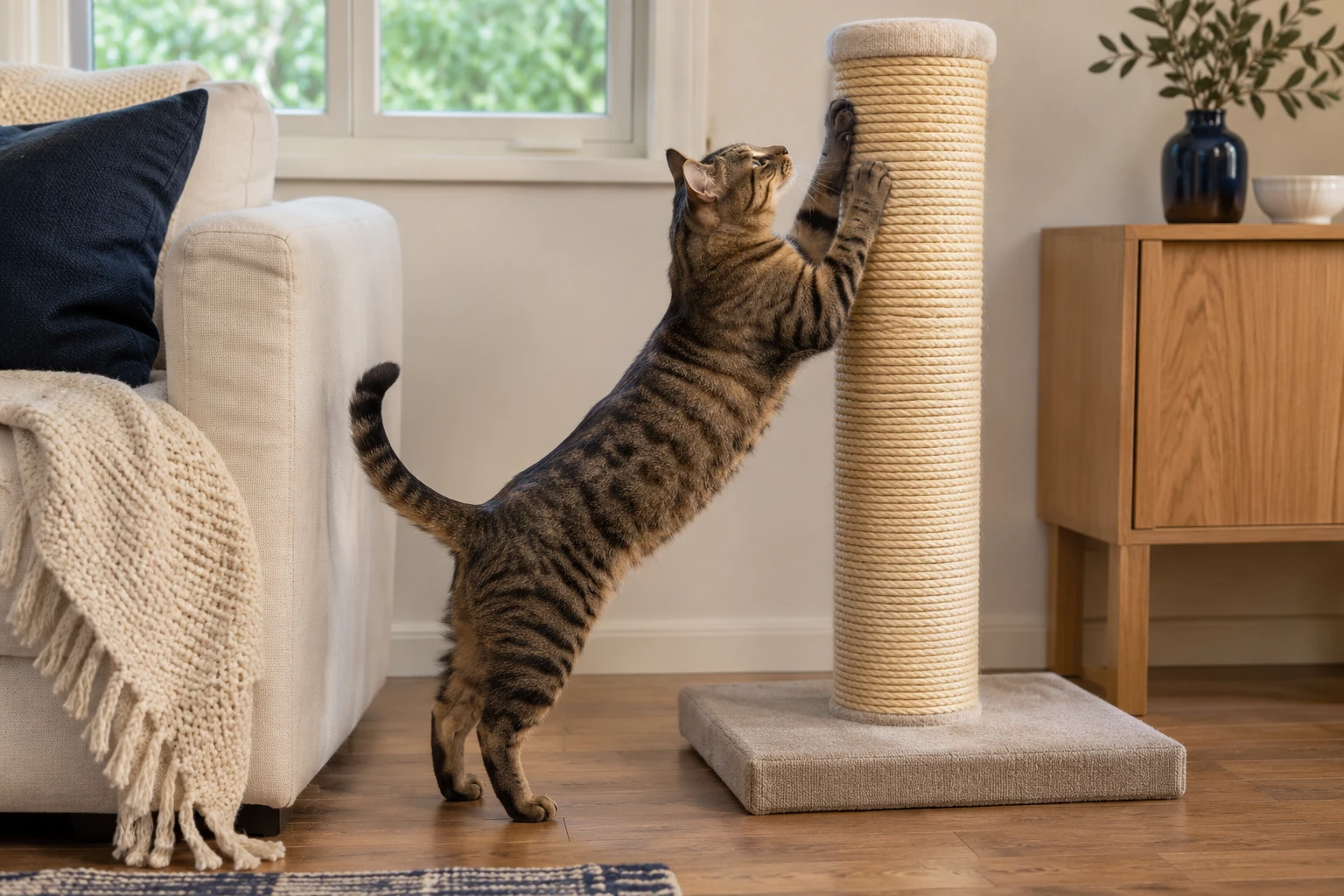
The best spot is often the one your cat already chose
The scratching post looks excellent in the corner. It fits beside the bookcase, leaves the sofa clear and has barely a thread out of place. Across the room, the sofa arm tells a different story.
Before replacing the post, try reading that contrast as useful information. Your cat has shown you a location, a surface and a way of stretching. The task is to offer an acceptable scratching place that answers those preferences, while protecting the furniture you want to keep.
Cats Protection recommends placing a scratcher beside the area already being scratched, with a stable base and enough height for a full stretch. A horizontal pad may suit a cat who scratches at floor level. Start there, then observe. There is no universal distance from a sofa, or a room corner, that makes a post the right choice.
Look at the marks before you move anything
Make a small sketch of the room, or take a photograph for your own reference. Mark the sofa edge, carpet patch or other surface your cat returns to. Note which side is used, whether the scratches run up a vertical face or across the floor, and where your cat stands while scratching.
Then look at the approach. Can your cat reach the existing post without squeezing behind furniture? Does a door swing into it? Is it wedged beside a noisy appliance? These questions help you spot practical obstacles; they are not a way to diagnose why a cat scratches.
Add your cat’s regular sleeping places to the sketch. Scratching after waking is common, so a nearby option may be worth trying. For this first pass, choose one observation to act on: perhaps the post is too far from the sofa corner your cat actually uses. You do not need to redesign the whole room.
Check the scratcher before asking location to solve everything
A move cannot make a wobbling post feel secure. Follow its assembly instructions, check fixings and examine the base on the intended floor. Remove it from use if it is damaged or unstable. A tall post that shifts under a cat’s weight needs attention before any placement experiment.
Compare the surface and angle with what your cat chooses. A vertical sisal post and a flat cardboard pad offer different experiences. The Feline Veterinary Medical Association’s Cat Friendly Homes guidance encourages attention to those preferences rather than punishment. An expensive object can still be the wrong shape for a particular cat.
Inspect worn areas for loose parts or exposed fastenings. Looking used is not, by itself, a reason to discard a familiar scratcher; the ASPCA notes that cats may prefer a well-used surface. Safety and structural condition matter more than whether it looks new in a photograph.
Place the alternative where it can compete
Set a suitable scratcher beside the selected scratching area, leaving room for your cat to stand and stretch. Keep household routes open and follow the product’s instructions for installation or anchoring. A wall-mounted design needs the specified fixing method, not an improvised attachment.
If the sofa arm is the chosen spot, putting the alternative on the other side of the room asks your cat to make a much bigger change. Begin with convenience. If a resting place is the better clue, try a stable scratcher nearby without crowding the bed or blocking an exit.
A furniture cover can protect an area while you offer the alternative, provided it is secure and suitable for the furniture and household. Avoid loose coverings that become snagging hazards. Do not use frightening interruptions or force your cat’s paws against the surface. Let the cat investigate and leave freely.
Run a simple observation, not a test your cat can fail
Keep the setup consistent enough to notice what happens. Record which surface is used and the broad circumstances: after a nap, during a normal evening, or when the room is quiet. A note such as “used the pad after breakfast” is more useful than “good cat today”.
For a first observation period, choose several ordinary days when you are around to notice. That is an organizational suggestion, not a promised training timetable. An unused post on one afternoon does not prove the idea failed.
- Did the cat approach the scratcher without hesitation?
- Was it stable during use?
- Was the surface actually scratched, rather than simply sniffed?
- Could another cat block the approach?
When your cat uses the intended surface, offer a reward they enjoy without interrupting or restraining them. Keep any food reward within their usual feeding plan.
Change one useful thing at a time
If the scratcher remains unused, revisit the observation. A horizontal pad may be a more sensible next trial than moving the same vertical post through five corners. If the object is used, resist immediately hiding it away for aesthetic reasons.
Where a later move is necessary, make it gradual and watch whether use continues. Keep a helpful option available near the original problem area rather than removing every alternative at once. In a home with several cats, think about separate locations and access, not merely a row of posts in one place.
A brief record also prevents accidental overbuying. Before adding another product to a basket, you can see what you tried, what was used and what remains uncertain. The goal is a reliable scratching opportunity, not a collection of nearly identical objects.
A few questions that come up in real rooms
Should the post be hidden behind the sofa?
Only if that position is accessible and useful to your cat. A discreet location that is awkward to reach can be a poor alternative to a prominent sofa edge.
Can I throw away the old post as soon as the new one arrives?
Keep a safe, familiar option while you see whether the replacement is used. Retire damaged equipment, but do not assume pristine material is automatically preferable.
What if the scratching suddenly changes?
A new or concerning change deserves a conversation with your veterinarian, especially alongside other changes in your cat. A placement exercise cannot determine whether discomfort, stress or another problem needs attention. A qualified behaviour professional may also help with persistent difficulties.
Make the room work around a real cat
At the end of the exercise, keep the version that is useful and safe, even if it is not where you first pictured it. A post beside a sofa can be part of a well-considered room, just like a reading lamp beside a chair. Both belong where they serve their purpose.
For the larger picture, explore Catopedia’s indoor enrichment guide. This project handles one small decision: giving your cat a place to scratch that makes sense from their side of the room.