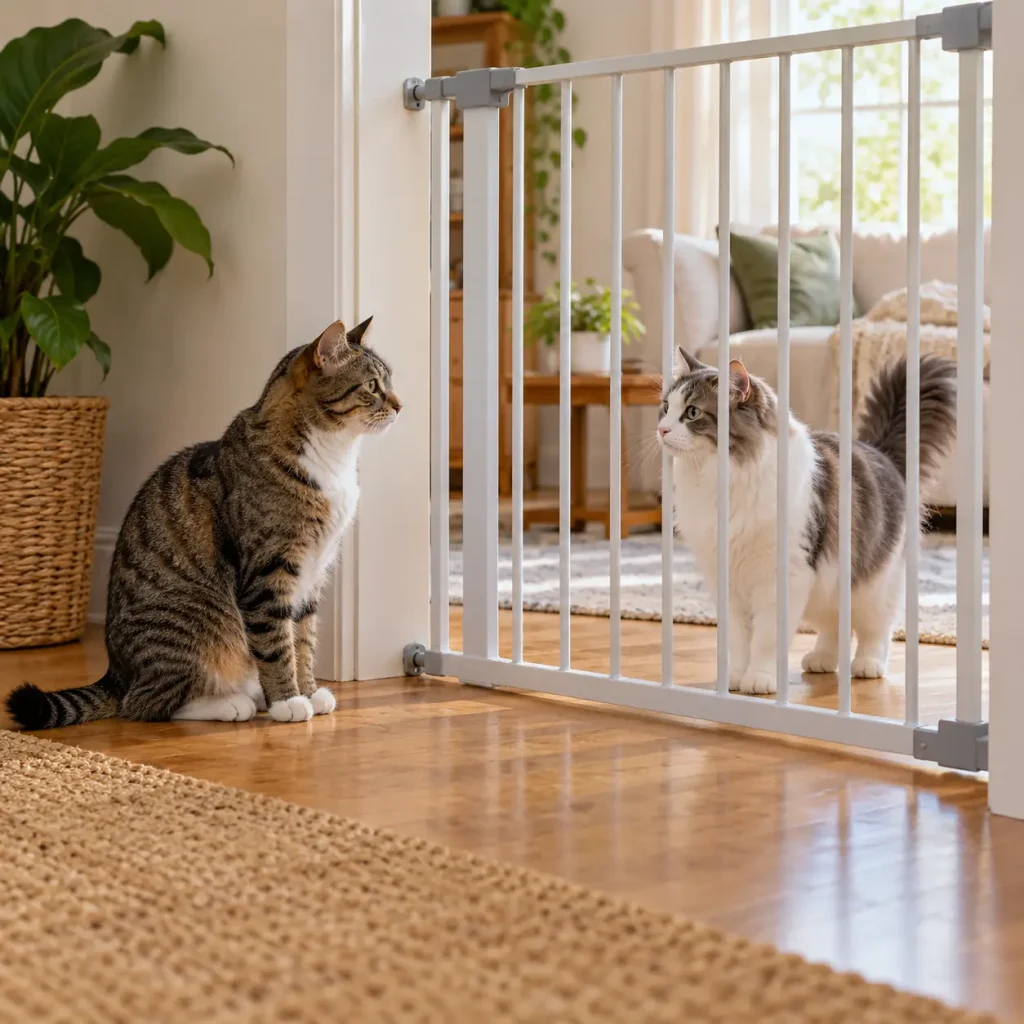
Begin with complete separation and abundant resources. Progress through scent, sound, controlled visual access and short supervised sessions only while both cats remain comfortable and able to disengage.
Introductions are not linear and there is no universal timeline. Compatibility, health, previous experience, territory and household setup all affect progress.
Never hold cats together, force nose-to-nose contact or leave tense cats unsupervised. Separate safely after aggression and seek veterinary or qualified behavior support when risk is significant.
Prepare before the cats meet
Set up a transition room for the newcomer with food, water, litter, hiding, scratching, resting and elevated options. The resident cat should retain dependable access to familiar resources and attention.
Provide multiple separated resources throughout the home. The ability to avoid another cat while reaching essentials reduces competition and makes later interactions more manageable.
How to put this into practice
Treat this part of the plan as an observable process rather than a one-time task. Begin with the least disruptive change, keep the surroundings predictable and watch how the individual cat responds before adding another variable. The useful question is not whether a household followed a rigid timetable, but whether eating, drinking, elimination, movement, grooming, rest and social behavior remain comfortable and consistent. Make one change at a time whenever possible so improvement or difficulty can be connected to a likely cause.
Record the starting point, the adjustment made and what happened afterward. A brief note about time, place, duration and body language is more useful than a label such as good, difficult or stubborn. Household members should use the same cues and boundaries. If the response becomes less comfortable, reduce intensity, restore distance or return to the last successful step. Progress can be gradual and still be meaningful.
Begin with complete separation
Allow the newcomer to settle without visual contact. Each cat should eat, eliminate, rest and interact normally in its own area. A closed door prevents rehearsing chasing or cornering before positive associations exist.
Do not interpret interest at the door as readiness for contact. Watch for prolonged staring, growling, avoidance, appetite change or reduced use of areas near the boundary.
How to put this into practice
Treat this part of the plan as an observable process rather than a one-time task. Begin with the least disruptive change, keep the surroundings predictable and watch how the individual cat responds before adding another variable. The useful question is not whether a household followed a rigid timetable, but whether eating, drinking, elimination, movement, grooming, rest and social behavior remain comfortable and consistent. Make one change at a time whenever possible so improvement or difficulty can be connected to a likely cause.
Record the starting point, the adjustment made and what happened afterward. A brief note about time, place, duration and body language is more useful than a label such as good, difficult or stubborn. Household members should use the same cues and boundaries. If the response becomes less comfortable, reduce intensity, restore distance or return to the last successful step. Progress can be gradual and still be meaningful.
Exchange scent gently
Swap bedding or use a clean cloth to collect facial-area scent without restraining the cat, then place it where the other cat can investigate or avoid it. Pair calm investigation with food, play or another valued activity.
If either cat becomes highly aroused, increase distance and use a less intense scent item. Repeated comfortable exposure is more useful than one dramatic exchange.
How to put this into practice
Treat this part of the plan as an observable process rather than a one-time task. Begin with the least disruptive change, keep the surroundings predictable and watch how the individual cat responds before adding another variable. The useful question is not whether a household followed a rigid timetable, but whether eating, drinking, elimination, movement, grooming, rest and social behavior remain comfortable and consistent. Make one change at a time whenever possible so improvement or difficulty can be connected to a likely cause.
Record the starting point, the adjustment made and what happened afterward. A brief note about time, place, duration and body language is more useful than a label such as good, difficult or stubborn. Household members should use the same cues and boundaries. If the response becomes less comfortable, reduce intensity, restore distance or return to the last successful step. Progress can be gradual and still be meaningful.
Build positive door routines
Offer meals, treats or play on opposite sides of the closed door, beginning far enough away that both cats remain relaxed. Gradually reduce distance over multiple sessions.
Sessions should end while behavior is still comfortable. A cat that cannot eat or play may be too stressed for the current setup.
How to put this into practice
Treat this part of the plan as an observable process rather than a one-time task. Begin with the least disruptive change, keep the surroundings predictable and watch how the individual cat responds before adding another variable. The useful question is not whether a household followed a rigid timetable, but whether eating, drinking, elimination, movement, grooming, rest and social behavior remain comfortable and consistent. Make one change at a time whenever possible so improvement or difficulty can be connected to a likely cause.
Record the starting point, the adjustment made and what happened afterward. A brief note about time, place, duration and body language is more useful than a label such as good, difficult or stubborn. Household members should use the same cues and boundaries. If the response becomes less comfortable, reduce intensity, restore distance or return to the last successful step. Progress can be gradual and still be meaningful.
Introduce controlled visual access
Use a secure barrier, partially opened door or other setup that prevents rushing and provides escape routes. Keep the first sessions brief. Reward looking away, relaxed posture and voluntary disengagement.
Avoid carrying one cat toward the other. If staring, stalking, lunging or hiding escalates, block the view calmly and return to an earlier stage.
How to put this into practice
Treat this part of the plan as an observable process rather than a one-time task. Begin with the least disruptive change, keep the surroundings predictable and watch how the individual cat responds before adding another variable. The useful question is not whether a household followed a rigid timetable, but whether eating, drinking, elimination, movement, grooming, rest and social behavior remain comfortable and consistent. Make one change at a time whenever possible so improvement or difficulty can be connected to a likely cause.
Record the starting point, the adjustment made and what happened afterward. A brief note about time, place, duration and body language is more useful than a label such as good, difficult or stubborn. Household members should use the same cues and boundaries. If the response becomes less comfortable, reduce intensity, restore distance or return to the last successful step. Progress can be gradual and still be meaningful.
Try short supervised shared time
Choose a larger space with several exits, vertical options and no narrow traps. Engage cats in parallel activities at comfortable distances. End the session before tension rises and separate when supervision ends.
Increase time gradually. Some cats become companions, while others succeed by sharing space peacefully with limited close interaction. Welfare—not forced friendship—is the goal.
How to put this into practice
Treat this part of the plan as an observable process rather than a one-time task. Begin with the least disruptive change, keep the surroundings predictable and watch how the individual cat responds before adding another variable. The useful question is not whether a household followed a rigid timetable, but whether eating, drinking, elimination, movement, grooming, rest and social behavior remain comfortable and consistent. Make one change at a time whenever possible so improvement or difficulty can be connected to a likely cause.
Record the starting point, the adjustment made and what happened afterward. A brief note about time, place, duration and body language is more useful than a label such as good, difficult or stubborn. Household members should use the same cues and boundaries. If the response becomes less comfortable, reduce intensity, restore distance or return to the last successful step. Progress can be gradual and still be meaningful.
Maintain the relationship
Continue distributing resources, play and resting options so one cat cannot control access. Observe subtle blocking, staring, displacement from preferred areas and unequal participation in household routines.
Changes such as illness, moving, visitors or outdoor cats can disrupt a stable relationship. Respond early by restoring predictability, increasing resources and reducing pressure.
How to put this into practice
Treat this part of the plan as an observable process rather than a one-time task. Begin with the least disruptive change, keep the surroundings predictable and watch how the individual cat responds before adding another variable. The useful question is not whether a household followed a rigid timetable, but whether eating, drinking, elimination, movement, grooming, rest and social behavior remain comfortable and consistent. Make one change at a time whenever possible so improvement or difficulty can be connected to a likely cause.
Record the starting point, the adjustment made and what happened afterward. A brief note about time, place, duration and body language is more useful than a label such as good, difficult or stubborn. Household members should use the same cues and boundaries. If the response becomes less comfortable, reduce intensity, restore distance or return to the last successful step. Progress can be gradual and still be meaningful.
Begin with the individual cat
Every recommendation in this guide must be interpreted through the cat’s age, health, previous experience, temperament, environment and current sense of safety. Two cats living in the same home may need different pacing, resources or professional support. Avoid comparing progress with a previous pet or an online timetable. Establish what is normal for this cat first, then look for trends.
Use the central aim of this guide as the decision test: Use separation, scent exchange, positive associations and gradual visual and physical access to reduce fear and conflict between cats. A plan is working when it supports normal daily functions and expands comfortable choices without creating avoidable pressure. Individual preference matters, but a sudden loss of a previously normal behavior deserves attention rather than being dismissed as personality.
Create a reliable baseline
Before changing the routine, write down what the cat currently eats, where it rests, how often it uses the litter box, when it plays, which people or animals it approaches and what situations cause retreat. Note mobility, grooming and vocalization as well. This baseline turns vague impressions into information that can be compared over several days.
Photos, short videos and a simple daily log can reveal patterns that are easy to miss in the moment. Record facts without deliberately provoking a response. A useful entry might say that the cat ate half a measured meal, urinated once and remained under a chair while visitors were present. This is more actionable than saying the cat had a bad day.
Organize the household for success
Consistency does not require a perfectly quiet home. It means essential resources are dependable and the cat can predict how people will behave. Agree on feeding, play, access, handling and safety rules before beginning. Children and visitors need clear instructions, and doors, barriers, carriers or storage areas should be checked before they are relied upon.
Place resources so the cat can use them without being trapped, watched or blocked. In multi-cat homes, duplication is not enough if every item is grouped in one location. Separate important resources and create more than one route through frequently used rooms. Choice reduces competition and gives the cat a practical way to regulate distance.
Adapt the plan across life stages
Kittens often need shorter, more frequent sessions and closer supervision because they learn quickly but have limited impulse control. Adults may bring established preferences or previous experiences. Senior cats can need easier access, warmer resting areas, lower entry points and veterinary assessment when a familiar activity becomes difficult.
Health status can alter behavior at any age. Pain, sensory change, dental disease, digestive upset and urinary problems may look like reluctance, irritability or a training failure. This guide provides general education, not diagnosis. A change that is sudden, persistent, escalating or accompanied by physical signs should be discussed with a veterinarian.
Measure progress without rushing
Choose a small number of indicators that match the topic, then review them at the same time each day. Useful measures can include appetite, litter use, time spent hiding, willingness to play, recovery after a startling event and ability to disengage calmly. Look for direction over several observations rather than demanding improvement in every session.
Plateaus and brief setbacks are common after visitors, noise, travel, illness or a change in household routine. They do not automatically mean the complete plan has failed. Reduce difficulty, protect essential routines and rebuild from a successful point. If progress remains stalled, ask a veterinarian or appropriately qualified behavior or nutrition professional to review the record.
Common mistakes to avoid
The most common error is changing too many things at once. Other problems include forcing interaction, removing hiding options, using punishment, relying on internet anecdotes as diagnosis, copying another cat’s treatment or expecting warning signals to disappear while the underlying cause remains. Marketing language and social-media popularity are not substitutes for evidence.
Do not wait for a crisis before collecting contact details and records. Keep the regular clinic, nearest emergency service, medication list, carrier and relevant history accessible. Never give human medication or another animal’s prescription unless a veterinarian specifically directs it for this cat. When uncertainty involves breathing, urination, consciousness, significant trauma or rapid deterioration, seek urgent professional help.
Questions to discuss with a professional
Bring specific observations and ask what findings would change the plan. Useful questions include: Which signs would make this urgent? What variation is expected for this age and history? How should progress be measured? Are there medical causes that should be ruled out? Which sources or credentials should be used when evaluating additional advice?
For nutrition or medical decisions, ask the veterinarian to explain benefits, limitations, monitoring and follow-up. For behavior concerns, begin with medical assessment and seek a professional who uses humane, evidence-informed methods. Share videos and logs when they can be collected safely. Good professional guidance should clarify decisions rather than promise an identical result for every cat.
A practical seven-day review
Day one is for setup and baseline notes. On days two and three, keep the environment stable and observe rather than escalating the plan. On days four and five, make one modest adjustment only if the cat remains comfortable. Use days six and seven to compare appetite, elimination, rest, movement, play and social behavior with the starting point.
At the end of the week, decide whether to continue, slow down, return to an earlier step or request professional advice. Seven days is a review point, not a universal deadline. Some circumstances need immediate veterinary care; others require several weeks of patient work. The record helps distinguish a normal gradual transition from a pattern that needs intervention.
Global and household differences
Products, food labels, veterinary schedules, parasite risks, animal-welfare rules and access to professional services differ between countries. Use locally applicable regulations and veterinary recommendations. When a guide mentions a product category or professional credential, confirm the equivalent recognized in your region.
Housing also changes what is practical. An apartment, multi-level home, foster room or busy family household may require a different layout while preserving the same welfare principles: safe retreat, dependable resources, gradual change, observation and timely professional help. Adapt the method without abandoning those underlying protections.
Final action checklist
Before moving forward, confirm that the physical environment is secure, essential supplies are available, household members understand the plan and the cat has a genuine way to retreat. Check that food, water, litter, rest, scratching and play opportunities are accessible. Decide which signs you will record and whom you will contact if concerns arise.
The safety boundary for this guide is clear: Never hold cats together, force nose-to-nose contact or leave tense cats unsupervised. Separate safely after aggression and seek veterinary or qualified behavior support when risk is significant. The professional-support boundary is equally important: Arrange veterinary assessment after sudden aggression or when pain or illness may be contributing. Seek qualified feline behavior support for injury, persistent stalking, resource blocking, severe fear or repeated failed introductions. When those limits are respected, careful observation and gradual adjustments can turn general guidance into a practical plan suited to the individual cat.
PROFESSIONAL SUPPORT
When to contact a veterinarian
Arrange veterinary assessment after sudden aggression or when pain or illness may be contributing. Seek qualified feline behavior support for injury, persistent stalking, resource blocking, severe fear or repeated failed introductions.
Medical/Veterinary Disclaimer →COMMON QUESTIONS
Frequently asked questions
How long does a cat introduction take?
It may take days, weeks or longer. Progress depends on the cats’ behavior, not a fixed schedule.
Should cats hiss during introductions?
A brief hiss communicates discomfort, but repeated or escalating tension means the current step is too difficult.
Can cats be left to work it out?
No. Uncontrolled conflict can cause injury and lasting fear. Use gradual, supervised steps.
EDITORIAL TRANSPARENCY
Sources, review and corrections
Editorial record
Author: Catopedia Editorial Team
Scope: Global
Sources and references
CONTINUE LEARNING